Do Americans Favor Attacking Iran Under the Current Circumstances?
University of Maryland Critical Issues Poll Findings
University of Maryland Critical Issues Poll
Shibley Telhami, Principal Investigator
As the Trump administration mobilizes U.S. military forces in the Middle East and President Donald Trump threatens possible military actions against Iran if it does not reach a negotiated deal with the United States, Americans have to contend with the possibility of being at war in the Middle East once again. Our latest University of Maryland Critical Issues Poll finds 21% of Americans favor the United States initiating an attack on Iran, 49% oppose, and 30% say they don’t know.
The latest poll was carried out by SSRS, February 5th – 9th, among a sample of 1,004 U.S. adults, with a margin of error of 3.5 percentage points.
Attitudes Toward Possible U.S. Military Attack on Iran
We asked respondents: “Do you favor or oppose the United States initiating an attack on Iran under the current circumstances?”

21% of respondents said they favored an attack on Iran, including 40% of Republicans, 6% of Democrats, and 21% of independents. Meanwhile, 49% said they opposed an attack, including 25% of Republicans, 74% of Democrats, and 51% of independents. Notably, many more Republicans (35%) than Democrats (19%) said they didn’t know.
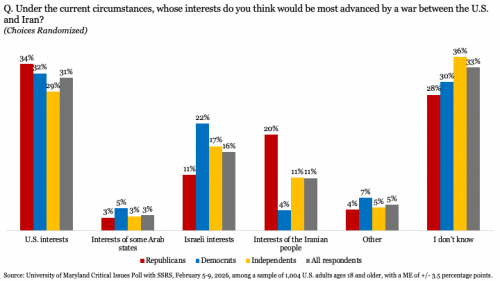
We followed up by asking: “Under the current circumstances, whose interests do you think would be most advanced by a war with Iran?”

Americans were divided with roughly one-third each saying war would most advance American interests (31%), most advance interests of other parties (35%), and those who said they didn’t know (33%). The other parties whose interests Americans said would be most advanced included Israel (16%), the Iranian people (11%), and some Arab states (3%). Far more Republicans (20%) said the interests of the Iranian people would be most advanced than Democrats (4%); and far more Democrats (22%) said Israeli interests would be most advanced than Republicans (11%).
Questions on the Epstein Files
The recent release of a large batch of the Epstein files has generated much national and international interest, even though only a portion of the millions of files have been analyzed. We fielded one question that probed public perception of Epstein’s possible foreign intelligence links, and one question on the impact of how Americans view President Donald Trump in light of the latest files released on January 30, 2026.
We asked: “As you may know, the U.S. Justice Department released a large batch of files related to convicted sex offender Jeffrey Epstein. Based on what you have heard, do you believe that Epstein was most likely connected to a foreign intelligence service?”

A plurality of respondents (42%), including 49% of Republicans, 35% of Democrats, and 38% of independents said they didn’t know. Eighteen percent said Epstein had no foreign intelligence service connection, with little difference across the partisan divide; while 40% said that Epstein had a likely connection to a foreign intelligence service, including 32% of Republicans, 47% of Democrats, and 44% of independents.
Most of those who said there was a foreign intelligence connection (33% of the total sample) said they didn’t know which foreign intelligence it was, while a minority (7% of the total sample) specified in an open-ended question one or more countries whose intelligence service they thought was most likely connected to Epstein. Of the 7% who specified, a majority, 63%, identified Israel, followed by Russia (32%), keeping in mind that this breakdown is not statistically significant given the small numbers.
We followed with a question about the impact of the files released on the public’s views of President Trump: “Based on what you have heard, how do the latest Epstein files impact your views of President Donald Trump?”

Nearly half of respondents, 49%, including 17% of Republicans, 77% of Democrats, and 53% of independents said their views of Trump were more negatively impacted, compared to 4% who said they were more positively impacted, including 8% of Republicans and 3% each of Democrats and independents. Thirty-six percent said their views were not impacted, while 11% said they didn’t know.
Conclusion
It’s important to keep in mind that public attitudes toward a possible war with Iran could change over time depending on the circumstances, especially as nearly one-third of Americans say they “don’t know” if they favor or oppose the U.S. initiating an attack. If President Trump does initiate an attack on Iran and make a case to the American people, we could see a shift in position of a segment of the public, especially among Republicans, at least in the early phases of conflict. But for now, the war option is clearly not popular among Americans, including among Republicans.
With regard to the Epstein files, it’s clear that early revelations from the recent release have hurt Trump’s standing among the American public. With hundreds of thousands of files still to be carefully analyzed, it is hard to see how things could get better for the president.