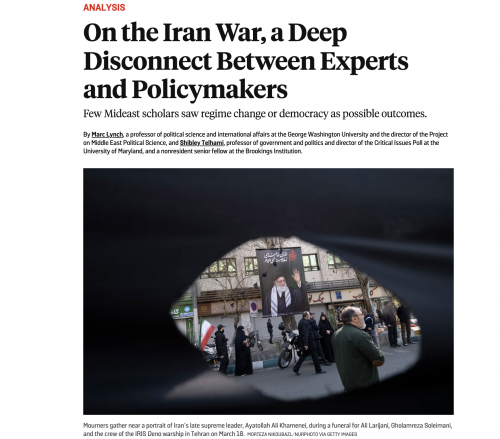
We are pleased to share the results of the latest round of the Middle East Scholar Barometer (MESB) that Professor Shibley Telhami co-directs with Professor Marc Lynch, as well as their joint article in Foreign Policy analyzing the results that pertain to the ongoing Iran war. The MESB polls scholars specializing in the Middle East who are members of the American Political Science Association, the American Historical Association, the Middle East Studies Association, and those affiliated with the Project on Middle East Political Science. This year, the MESB had 641 respondents, with roughly three-quarters of them based in the United States and over half being political scientists.
As Telhami and Lynch note in their article, "Many Americans opposed going to war against Iran, including some Republican voters, but among academics who study the Middle East, the opposition was overwhelming. Only 5 percent of academic experts polled in the days leading up to the Feb. 28 U.S.-Israeli attacks supported launching a war and only 1 percent thought that a broad assault would produce a pro-American democratic regime in Iran. Some 94 percent of experts thought the Trump administration's approach to Iran was making such a war more likely - an overwhelming consensus. Expert knowledge is often dismissed by this administration but in retrospect it seems that academics understood better than policymakers the cohesion of Iran's regime and its ability and willingness to fight back."
Notably, their latest survey period of Feb. 19 to March 11 spanned the launch of the war, with about one-third of the responses coming after it began, allowing an unusual opportunity to assess changes in views after the fighting got underway. While the start of the war didn't substantially affect the scholars' responses, there were areas where it did. For example, in the days before the war, 26 percent said that a new nuclear deal was "very unlikely" under the Trump administration, going up to 62 percent after the war started.
Over the past few years, Telhami and Lynch have been probing the extent to which scholars self-censor when speaking about the Middle East professionally. As they noted in their article in Foreign Policy, "in every poll that we have carried out since the start of the war in Gaza, more than three-quarters of U.S.-based scholars said that they self-censored. This round was no exception, with 77 percent of scholars saying they self-censored on those issues and 81 percent of them worrying most about criticizing Israel, compared to 11 percent who worry about criticizing the Palestinians and 6 percent who worry about criticizing U.S. policy. This year, before the United States and Israel attacked Iran, Telhami and Lynch added a question about self-censorship on issues related to Iran, mostly to establish a baseline to show how exceptional the silencing of voices is on Israel-related issues. As we expected, prior to the war, only 17 percent of respondents (including 20 percent in the United States) said that they did feel the need to self-censor on Iran - a larger number than is healthy in any normally functioning academic environment but nothing close to the toxic climate surrounding discussion of Israel. After the war got underway, those numbers doubled to 33 percent overall and a remarkable 40 percent in the United States." Telhami and Lynch offer some possible explanations for these results in our article.
The MESB went well beyond the Iran war and self-censorship, including repeat questions tracking change over time. On the Israeli-Palestinian issue, which we have been probing in all of our previous polls, it is notable that there was a rise in the percentage of scholars describing Israeli actions as "genocide," going from 46 percent last year to 54 percent this year, with another 32 percent saying they were "major war crimes akin to genocide." There was also an increase in the percentage of scholars who see the current reality in Israel/Palestine as a "one state reality akin to apartheid" from 62 percent to 68 percent. Respondents were very pessimistic about the Trump Board of Peace that followed the official Gaza ceasefire declaration: Three-quarters of the respondents said it will make a two-state solution in Israel/Palestine less likely, and four-out-of-five said it increases the likelihood of Israeli annexation of the West Bank.

You can find the full questionnaire here, the link to the Foreign Policy article here.