Tracking Opinion on Iran War: Rising Majority Want War to End Now
Fifty-eight Percent of Democrats Back US Reparations to Iran
University of Maryland Critical Issues Poll
Shibley Telhami, Principal Investigator
After threatening massive new bombings of Iran, including strikes on its energy infrastructure, President Trump abruptly called off the attack, saying he had been asked by several Middle Eastern states—as well as Iran—to hold off because new negotiations were forthcoming. Iran, however, promptly denied both that it had made such a request and that any new negotiations had been promised. The president had received a call from Saudi Crown Prince Muhammad bin Salman, reportedly urging him not to commence the attack on the grounds that it could be economically devastating to the Gulf Arab states, which to Trump could also mean their inability to fulfill a reported commitment to invest heavily in the American economy in the coming years. Certainly, further energy shortages would undermine the American economy as the US approaches the midterm elections.
Yet it’s hard to know if Trump’s decision to hold off on the attack is simply tactical and temporary. As the Associated Press pointed out, the president had announced he was halting strikes in Iran at least eight times since April, only for more attacks to take place. On the other hand, it’s hard to know if the original threat was simply a tactic to compel Iranian concessions, with no serious intent to follow through. There are compelling reasons to suspect the latter.
For one thing, the multiple rounds of bombings and escalations in the past few months have not succeeded in softening Iran’s positions, and American military leaders are warning of serious shortages of munitions, both defensive and offensive, that are undermining the US military posture globally. The Commander of US European Command has warned publicly that the US shortage of destroyers that have advanced air defenses is forcing him to choose between defending the American homeland and defending Israel. Finally, there is American public opinion, which has been consistently opposed to the war, as almost every poll has shown since its outset.
Even before the war, our own University of Maryland Critical Issues Poll began tracking public opinion toward the possibility of US military action against Iran, with our first poll on the issue, fielded February 5–9, 2026, showing only 21% of Americans, including a minority of Republicans, backing the initiation of war.
In the past month, we have carried out two consecutive polls, one July 17–19, followed by another July 20–26. We had reported the results of the first poll, which showed a majority of Americans, 52%, wanted the war to end “now” and to pursue any unachieved goals only diplomatically, compared to only 24% who said such goals should be pursued even through war.
Our latest poll carried out with SSRS, less than a week later, shows rapid, measurable increases in the number of Americans wanting the war to end “now” and a surprising, increasing openness by the American public, especially Democrats, toward reparations to Iran for war damage. Within nearly a week, talk of war escalation appears to have increased US opposition to the war measurably, instead of rallying Americans behind the threatened US attacks.
Here are some of the key takeaways:
Growing Majority Wants the War to End “Now”
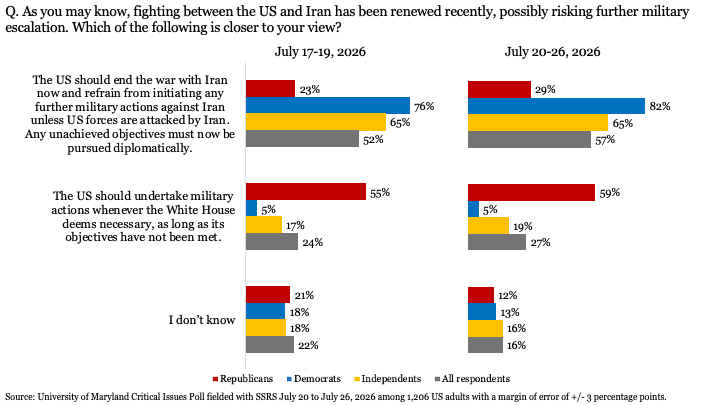
We asked respondents, “As you may know, fighting between the US and Iran has been renewed recently, possibly risking further military escalation. Which of the following is closer to your view?” Respondents chose from three options: “The US should end the war with Iran now and refrain from initiating any further military actions against Iran unless US forces are attacked by Iran. Any unachieved objectives must now be pursued diplomatically.”; “The US should undertake military actions whenever the White House deems necessary, as long as its objectives have not been met.”; and “I don't know.”
In less than a week, as fears of war escalation grew, those wanting to end the war “now” rose from 52% in mid-July to 57% in late July, including among Republicans whose support for immediately ending the war grew from 23% to 29%. Among Democrats, support increased from 76% to 82%.
Twenty-seven percent of respondents said the United States should undertake military action as long as its objectives have not been met, including 59% of Republicans, 5% of Democrats, and 19% of independents. Among Republicans, support for this position increased by 4 percentage points.
Certainty also increased. The share of respondents who said “I don't know” fell from 22% to 16%. Among Republicans, it declined from 21% to 12%, while 13% of Democrats and 16% of independents said they did not know.
Rising Number of Americans Back Iran Reparations
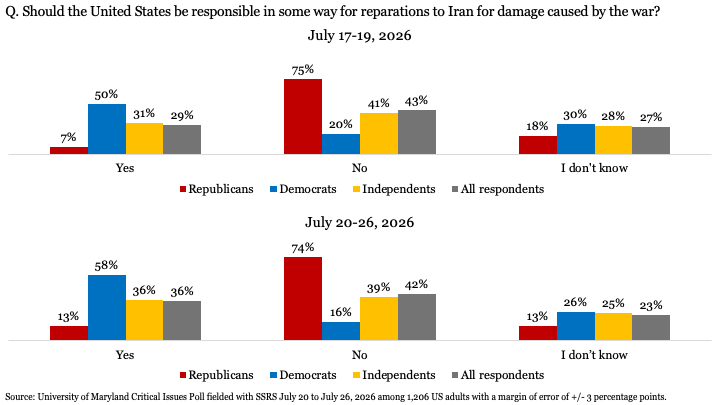
We asked respondents whether the United States should be responsible for reparations to Iran for damages caused by the war.
From mid to late July, support for reparations increased: Thirty-six percent of respondents said the United States should be responsible for reparations, up 7 percentage points. Among Democrats, support increased from 50% to 58%, while support among Republicans rose from 7% to 13%. Among independents, support increased from 31% to 36%.
Nearly one-quarter of respondents said “I don't know,” down slightly from 27% the week before.
Only 25% of Americans Back Using Force to Prevent Iran Nukes
We asked respondents, “Israel is known to have nuclear weapons while many believe that Iran may be trying to develop such weapons. Which of the following is closer to your view?” in two surveys fielded one week apart (July 17–19 and July 20–26).
Respondents chose from the following options: “The US should focus on preventing Iran from having nuclear weapons—even by war.”; “The US should focus on preventing Iran from having nuclear weapons—but without the use of military force.”; “The US should not focus on preventing Iran from having nuclear weapons.”; “The US should focus on turning the Middle East into a nuclear-free zone, including both Israel and Iran.”; and “I don't know.”
One-quarter of respondents said the United States should focus on preventing Iran from obtaining nuclear weapons, even by war, up 4 percentage points from 21% in mid-July. Support increased among Republicans from 46% to 52% and among independents from 12% to 19%.
Support for preventing Iran from obtaining nuclear weapons without the use of military force changed little between the two surveys. Twenty percent of respondents held this view, including 12% of Republicans, 28% of Democrats, and 22% of independents.
Eight percent of respondents said the United States should not focus on preventing Iran from obtaining nuclear weapons, including 3% of Republicans, 10% of Democrats, and 9% of independents. Among Republicans, support for this position declined from 7% in mid-July to 3% in the latest survey.
A plurality of respondents (31%) said the United States should focus on making the Middle East a nuclear-free zone, including both Israel and Iran, up from 22% in mid-July. Support for this position increased by 9 percentage points among Republicans (15% to 24%), 12 percentage points among Democrats (26% to 38%), and 8 percentage points among independents (27% to 35%).
Uncertainty declined sharply across all partisan groups. The share of respondents who said “I don't know” fell from 26% in mid-July to 17% in the latest survey. Among Republicans, it declined from 18% to 9%; among Democrats, from 25% to 17%; and among independents, from 29% to 15%.
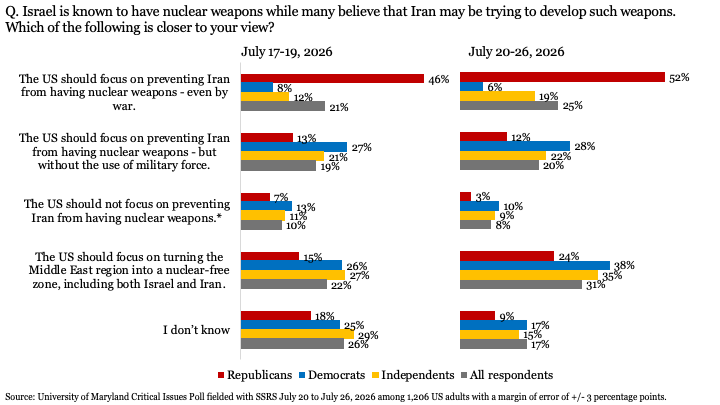
* In the survey fielded July 17–19, 2026, we used expanded wording on question option three, which read as “The US should not focus on preventing Iran from having nuclear weapons as a nuclear Iran and already-nuclear Israel could deter each other.” We subsequently shortened this response option in the survey fielded July 20–26, 2026, as represented in the chart above.
Only Sixteen Percent Say the US Is Winning
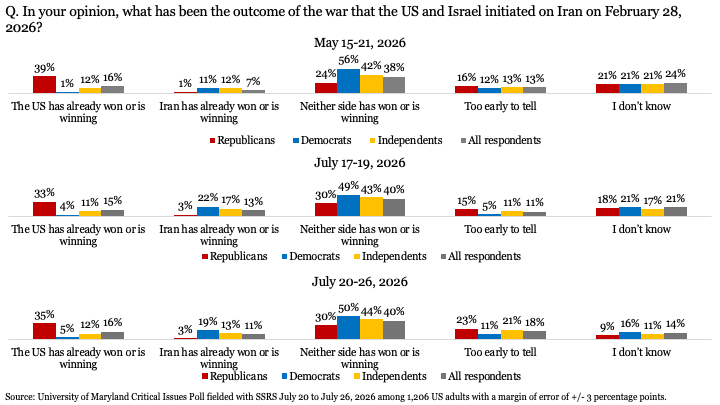
Only 16% of respondents said the “US has already won or is winning,” including 35% of Republicans, 5% of Democrats, and 12% of independents. Compared with mid-May, the share of Republicans holding this view declined by 4 percentage points, while the share of Democrats increased by 4 percentage points.
A plurality of respondents (40%) said “neither side has won or is winning,” including 30% of Republicans, 50% of Democrats, and 44% of independents. This is little changed from mid-May (38%). Compared with mid-May, however, the share of Republicans holding this view increased by 6 percentage points (24% to 30%), while the share of Democrats declined by 6 percentage points (56% to 50%).
Views that “Iran has already won or is winning” rose sharply after mid-May before easing slightly. In mid-May, 7% of respondents held this view, including 11% of Democrats and just 1% of Republicans. By mid-July, that share had risen to 13% overall, including 22% of Democrats and 3% of Republicans. By late July, 11% of respondents said Iran was winning, including 3% of Republicans, 19% of Democrats, and 13% of independents.
Eighteen percent of respondents said “it is too early to tell,” including 23% of Republicans, 11% of Democrats, and 21% of independents. Among Republicans, this increased from 16% in mid-May to 23% in the latest round of polling.
Uncertainty also declined over time. In mid-May, nearly one-quarter of respondents overall—including Democrats, Republicans, and independents—said they did not know. By late July, that share had fallen to 14%, including 9% of Republicans, 16% of Democrats, and 11% of independents.
Majority Say US Interests Are Negatively Impacted
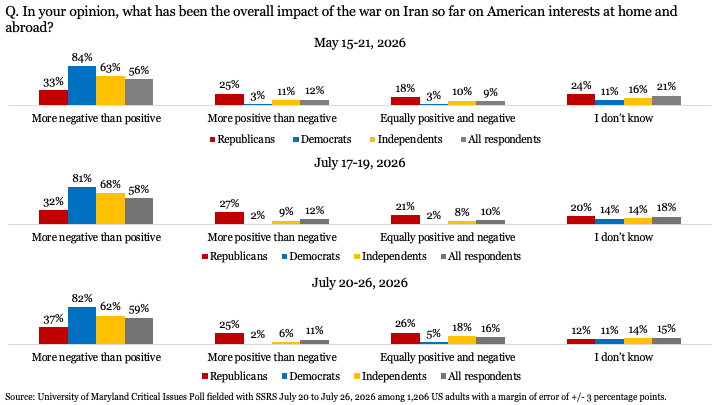
A majority of respondents (59%) said the war's impact on American interests has been more negative than positive, including a plurality of Republicans (37%), 82% of Democrats, and 62% of independents. Opinion has changed little since mid-May, when 56% said the same. The largest shift was among Republicans, where the share saying the war has had a more negative than positive impact increased by 4 percentage points (33% to 37%).
Eleven percent of respondents said the war has been more positive than negative, including one-quarter of Republicans. Republican views changed little between mid-May and the latest survey. Among independents, however, the share holding this view declined by 5 percentage points, from 11% to 6%.
Sixteen percent of respondents said the war's impact has been equally positive and negative, including nearly one-quarter of Republicans, 5% of Democrats, and 18% of independents. This is up from 9% in mid-May, when 18% of Republicans, 3% of Democrats, and 10% of independents gave this response. Compared with mid-May, the share choosing this option increased by 8 percentage points among both Republicans and independents.
Uncertainty declined as well. In mid-May, 21% of respondents said “I don't know,” compared with 15% in the latest survey. The shares of Democrats and independents changed little over this period, while the share of Republicans saying “I don't know” fell by half, from 24% to 12%.
Plurality of Americans Say War Is Illegal
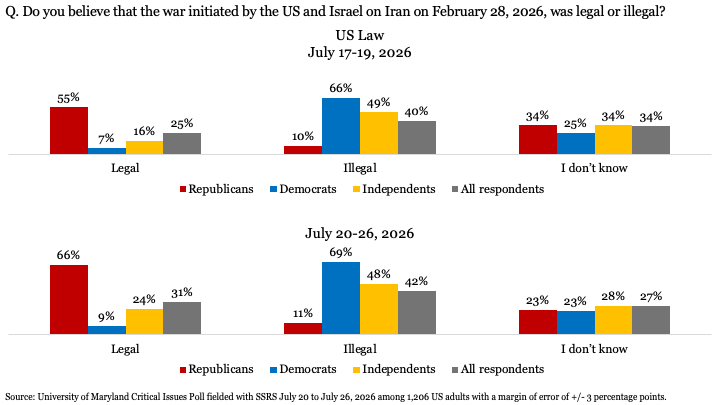
We asked respondents whether they believe the war was legal or illegal under US law.
A plurality of respondents (42%) said the war was illegal under US law, including 11% of Republicans, 69% of Democrats, and 48% of independents. Compared with mid-July, the share of Democrats holding this view increased slightly, from 66% to 69%.
About one-third of respondents said the war was legal under US law, up from one-quarter in mid-July. Two-thirds of Republicans held this view, an increase of 11 percentage points from the previous week, while support among independents increased by 8 percentage points to nearly one-quarter. Only 9% of Democrats said the war was legal under US law.
Uncertainty declined between the two surveys. A little more than one-quarter of respondents said “I don't know,” compared with about one-third a week earlier. Republicans and independents became more certain in their views, while Democrats remained relatively stable, with about one-quarter saying “I don't know.”
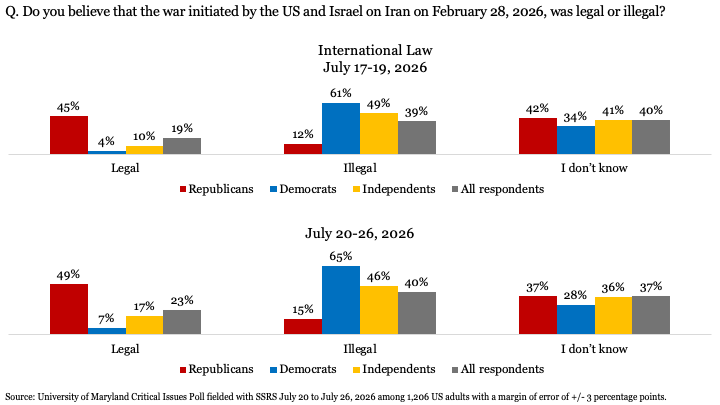
We also asked respondents whether they believe the war was legal or illegal under international law.
A plurality of respondents said the war was illegal under international law, with little change between mid- and late July. Forty percent of respondents held this view, including 15% of Republicans, 65% of Democrats, and 46% of independents.
Nearly one-quarter of respondents (23%) said the war was legal under international law, including nearly half of Republicans, 7% of Democrats, and 17% of independents.
More than one-third of respondents said, “I don't know.”
A Values Divide Overlaps with Partisan Divide
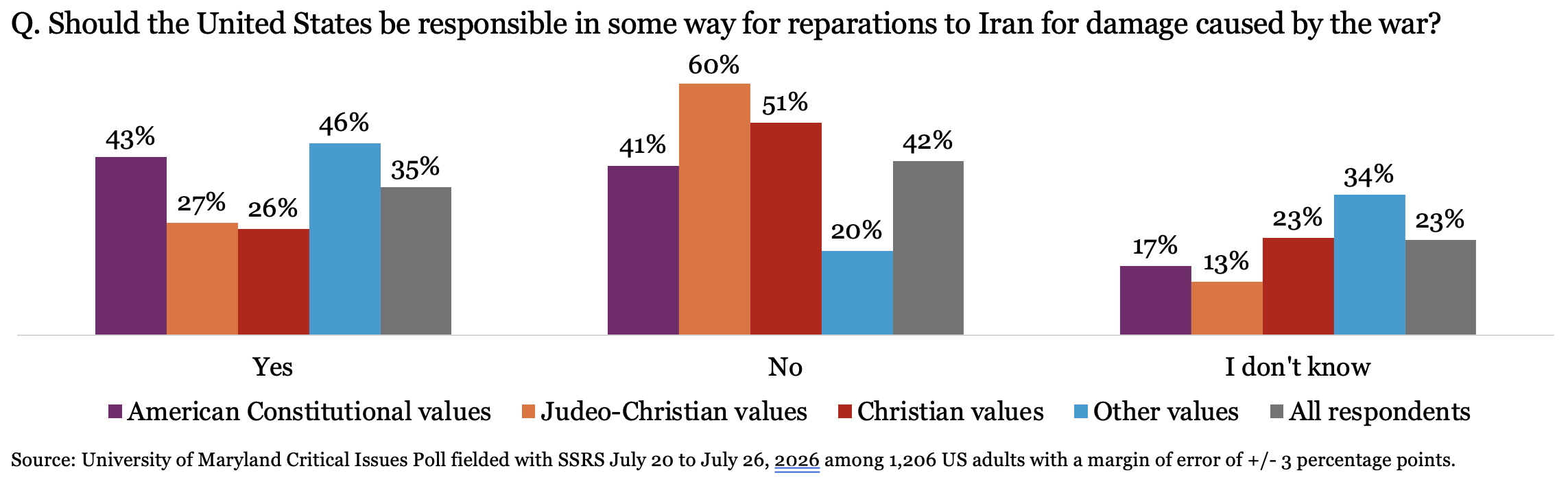
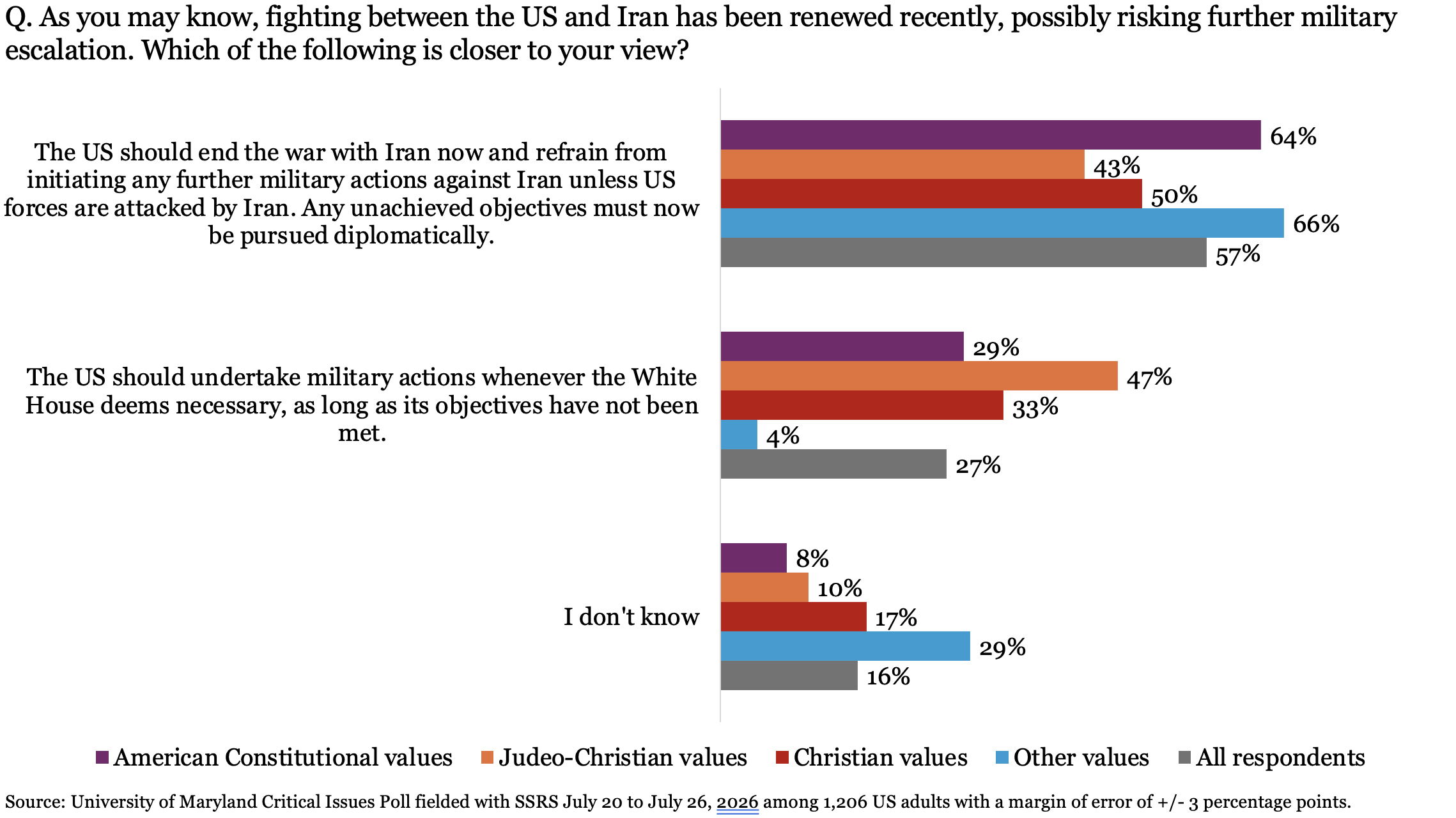
In the poll we also asked about how respondents prioritized their values, asking “Which one of the following most closely reflects your values?” with options for “American Constitutional values”; “Judeo-Christian values”; “Christian values”; and “Other.” We found that 40% said “Christian values” most reflect their beliefs, 33% said “American Constitutional values,” 6% said “Judeo-Christian values,” and 21% chose “other” values. We correlated these choices with two key questions about ending the war and support for Iran reparations. Here are the findings:
Those who said their values are most closely represented as “American Constitutional values” are split nearly equally on whether the United States should be responsible for reparations to Iran: 43% said “yes,” while 41% said “no.” At the same time, 60% of those who identify most with “Judeo-Christian values” said the US should not be responsible for reparations, 27% said the US should be responsible, and 13% said they did not know. Fifty-one percent of those who identify most with “Christian values” said no to reparations, 26% said yes, and 23% said they did not know. Among those who chose “other” values, a plurality, 46%, said yes to the US being responsible for reparations, 20% said no, and 34% said they did not know.
Two-thirds of those who identified most with “American Constitutional values” said the US should end the war now, 29% said the US should pursue military actions as long as it deems necessary, and 8% said they did not know. Meanwhile, a plurality, 47%, of those who identify more closely with “Judeo-Christian values” said the US should undertake military actions, and slightly fewer, 43%, said the US should end the war now. 10% said they did not know. Among those who said “Christian values” is closest to reflecting their values, half said the US should end the war now, one-third backed pursuing military actions, and 17% said they did not know. For respondents who chose “other” when asked about their values, two-thirds said the US should end the war now, with only 4% who favored military actions, and 29% who said they don’t know.
Concluding Thoughts
The American public’s concerns about the Iran war are only growing with threats of military escalation measurably increasing the public desire for ending the war immediately, even with unachieved White House objectives. In less than a week, there was a measurable increase in public anxiety amid fear of more fighting, while the focus on the threat of Iran’s nuclear program is failing to persuade the public to back more military action, as only one-quarter of Americans support using force to prevent Iran from developing nuclear weapons.
One notable finding is the growing number of Americans who feel the US should be responsible for reparations to Iran for war damage. In some ways, this is not surprising given that many Americans have felt the war is unjustified and a plurality in our latest poll say it is also illegal both according to US and international law. While it’s improbable that this administration—or even any other—would be politically able to commit to reparations in an ultimate peace deal with Tehran, the public may provide a possible indirect way to justify a workable arrangement in the Strait of Hormuz along the lines suggested by former CIA Director William Burns in his New York Times article in April, that “on the reopening of the strait, some agreement involving littoral states and other key global players could help durably protect free passage and generate some revenue for demining and economic recovery — without allowing an Iranian tollbooth."
Karenna Sarney assisted in the data analysis and graphing of this report.