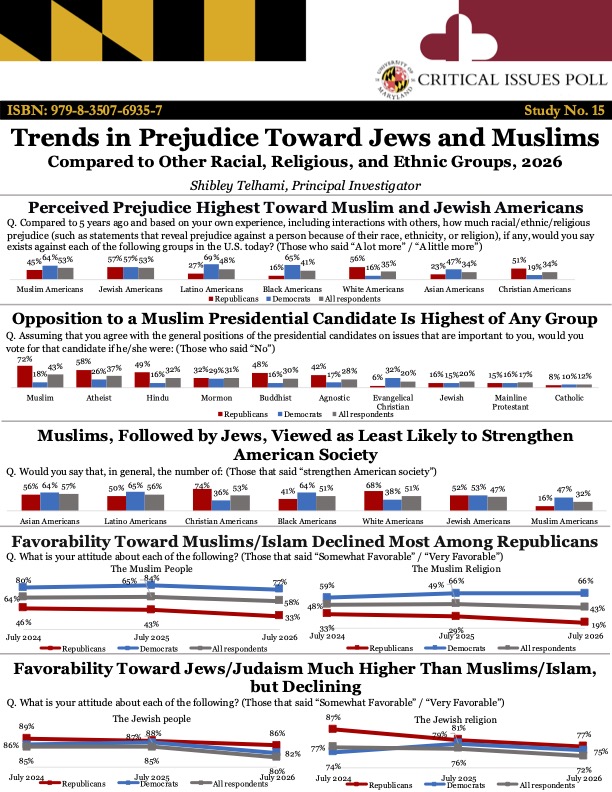
Director of the Critical Issues Poll, Professor Shibley Telhami is pleased to share the latest extensive report of the University of Maryland’s Critical Issues Poll on prejudice toward Jews and Muslims, compared to other religious, ethnic, and racial groups. Building on previous polls, this report analyzes our latest 2026 data to discern trends in prejudice over time both horizontally, or the extent to which prejudice becomes more widespread across the population, and vertically, or the extent to which prejudice becomes more intense, which could occur even without horizontal spread, typically measured by the number of observed incidents of prejudice.
In our polling, we provide an indirect measure of the vertical spread of prejudice by examining how Americans perceive changes in the incidence of prejudice. Beginning in 2022, we have asked respondents whether, based on their own experiences and interactions with others, they perceive more or less racial, ethnic, or religious prejudice against particular groups than they did five years earlier. In the latest survey, for example, a majority of Americans perceived more prejudice against both Muslim Americans and Jewish Americans than five years ago–more than for any other ethnic, racial, or religious group in our study, including Latino, Black, White, Asian, and Christian Americans.
The focus of this report, however, is primarily on the horizontal spread of prejudice. Our polling directly measures attitudes toward different racial, ethnic, and religious groups, allowing us to examine the extent to which prejudicial attitudes are held across the American population and how those attitudes have changed over time.
In addition to tracking the prevalence of prejudice, this report also measures change in how Americans define antisemitism and the extent to which they differentiate attitudes against Jews and Judaism from attitudes against Israel and Zionism. We have probed this issue in several polls in the past, including before October 7, 2023, and are thus able to track changes over time.
Finally, this report includes an assessment of change over time in the degree to which Americans feel the need to self-censor when they speak about the Israeli-Palestinian issue outside their homes, compared to the degree to which they feel the need to self-censor when speaking about the Russia-Ukraine issue.
Below are graphs of notable findings that appear on the cover of the report. The full report, including findings on antisemitism and self-censorship, can be accessed here.