By Calvert Jones, Marc Lynch, and Shibley Telhami
A student types a question into an AI assistant: what is the capital of Israel? The reply comes back: Jerusalem. It is a confident answer to one of the most contested questions in the world, recognized as settled by only a handful of countries, but presented to the student as an obvious and noncontroversial fact. That cuts to the heart of what is at stake as artificial intelligence enters one of the most politically charged fields in academia. The content of AI is not neutral -- and reliance on AI can erode the critical skills and contextual knowledge that would allow students to recognize how their tools are shaping their knowledge.
As a growing number of universities mandate the use of AI in the classroom and make AI tools available to students, scholars of the Middle East, like in most of academia, are consumed with questions about AI’s role in the classroom. For the first time, our bi-annual survey of scholars of the Middle East — drawn from members of the American Political Science Association, the Middle East Studies Association, the American Historical Association, and affiliated researchers — asked about a range of issues, including how AI is reshaping scholarship, the classroom, and public discourse on the region. We found that AI is entering this field unevenly, and often uncomfortably. Most said that AI has not affected their teaching, but those who said that it had were nearly unanimous in describing the effect as negative.
Scholars did not hold back in describing those effects: “Students are becoming incapable of learning”; “It's destroyed the Liberal Arts”; “Students are less likely to read and write.” Others described redesigning assignments, tightening exam conditions, and watching students accept AI-generated content as fact. These are not fringe reactions. They represent a significant and vocal share of a field already navigating intense political pressures.
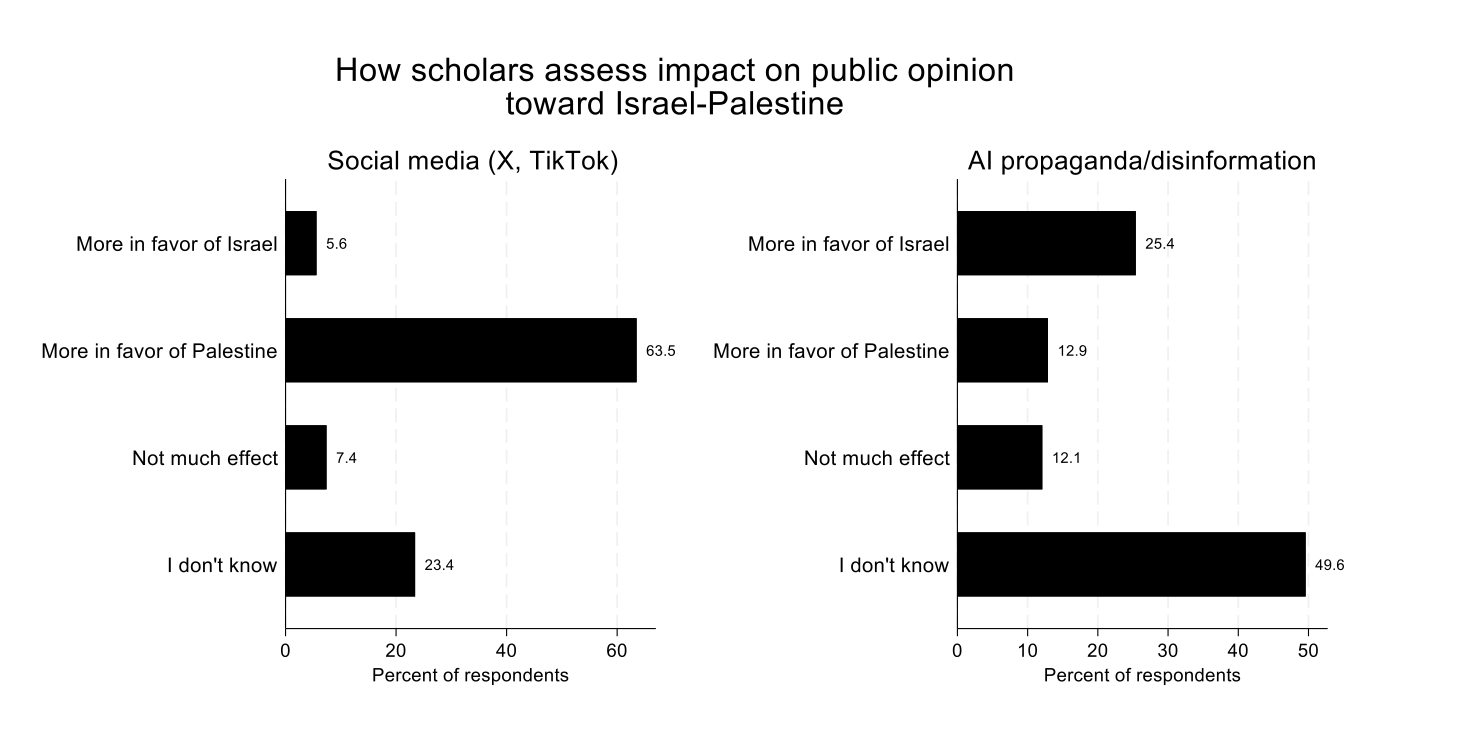
There was also a remarkable difference in how scholars perceive the effects of social media versus AI on broader public discourse. Regarding Israel-Palestine, 25% said AI-generated propaganda and disinformation had shifted U.S. public opinion more in favor of Israel (with only 13% saying more in favor of Palestine). Yet 64% said social media platforms like X and TikTok had moved opinion more in favor of Palestine. In other words, scholars perceive these two technologies as pushing public opinion in opposite directions. That aligns with major polls over the past two years by Pew, Gallup, and University of Maryland, which have shown that swings in sympathy toward Palestinians have been in part a function of younger people’s use of social media, especially TikTok, over legacy media. In reality, a University of Maryland poll has shown that it was not only those who got their news from social media who swung toward the Palestinians, but almost all those who got their information outside of Fox News.
AI and social media are not fully distinct, of course. Fully half of respondents said they simply didn't know how AI had shaped public opinion, compared to just 23% who said the same about social media. Complicating this picture is the outsized role that fake, AI-generated videos posted on social media may be having on public opinion, even when the fakes are debunked.
These results are likely based in part on the broader public discourse about the impact of social media and AI on public opinion. But there are very distinct dynamics when it comes to the Middle East, where prominent players in shaping the technology have expressed strong views and have incentives to put unseen fingers on the ideological scales. Israel has reportedly taken efforts to sway AI searches on Israel/Palestine in favor of Israel, and there is likely far more going on behind the scenes.
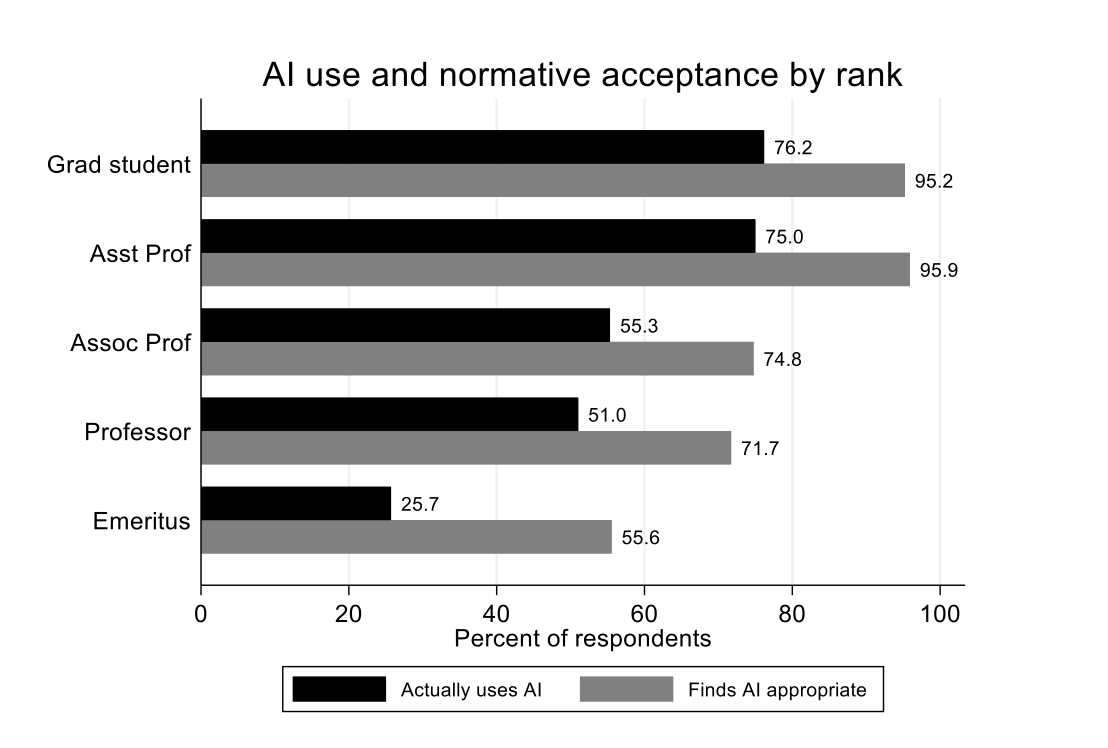
The contrast points to something scholars are grappling with across the board: AI is reshaping their field in ways they are still struggling to assess, and the implications reach well beyond public opinion. The picture that emerges from our data is not one of a field united in resistance or enthusiasm — it is one of a field absorbing a new technology at strikingly different rates, depending on who you are and where you work. AI use drops at every step up the career ladder, from 76% of graduate students to just 26% of emeritus professors. And that pattern holds for normative acceptance as well: senior scholars are not only less likely to use AI, but they are also less likely to find it appropriate. Overall, fewer Middle East scholars tend to use AI (55%), compared to the 77% of college faculty broadly polled in the 2025 College Board survey.
Geography also matters. Scholars outside the United States are heavier users, and notably more likely to have used AI translation tools and found them reliable. Inside the U.S., most scholars have never even tried AI translation tools. Moreover, inside the U.S., roughly 29% of scholars say they would punish students caught using AI. Outside the U.S., that figure drops by nearly half, to 16%. Distinct pedagogical cultures are developing around the same technology — one more restrictive, one more pragmatic.
Yet despite this unevenness, something surprising emerges: a field more open to AI than the opening reactions might suggest, and more unified in its judgments about where AI belongs than its internal divisions would predict. Scholars broadly agree that AI is acceptable for clerical and mechanical tasks: citation formatting, editing, organizational assistance. And they agree, just as broadly, on where it does not belong. Less than 3% find AI appropriate for peer review — a finding that holds regardless of who you are or where you work. Whatever else divides this community, there is near-universal agreement that AI should not be evaluating scholarly work. Notably, while the 2025 College Board survey uses somewhat different categories of AI use, they too find that AI is least used for peer reviews, with only 3% saying they use it for this purpose.
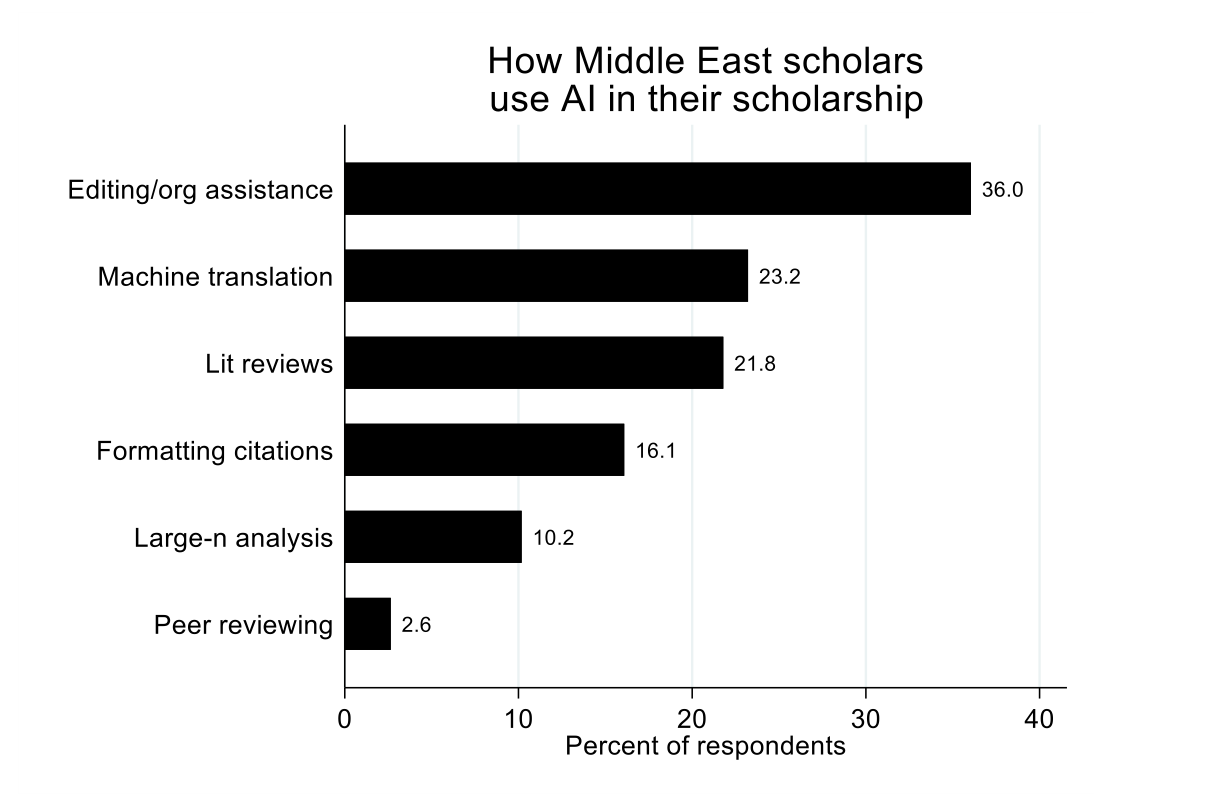
The fact that normative acceptance of many AI uses — editing, citation formatting, translation — outpaces actual adoption rates across all ranks, disciplines, and locations is also important. It creates space for the field to find its footing, identify the AI uses that genuinely improve scholarship and teaching, and reach consensus on those that do not, or that cross a line.
As for the Jerusalem question: when we recently posed it to several AI chatbots, none replied with a simple answer. All flagged the dispute, noting the contested designation, the limited international recognition, and the gap between political assertion and legal consensus — a more careful response than many might expect from tools so often accused of spreading misinformation. That is a reminder that AI is a moving target. The field's conversation about how to use it effectively and responsibly needs to move with it - even as it remains on guard that hidden hands may sometimes be tipping the scale.