Professor Shibley Telhami has recently released two poll-based articles. The first is an article on U.S. public opinion toward the Iran war, based on our latest University of Maryland Critical Issues Poll fielded with Ipsos.
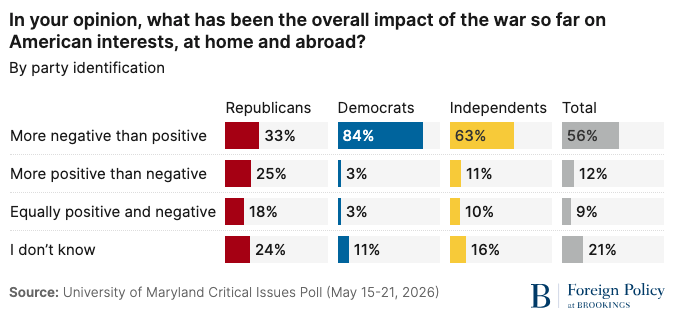
Most Americans say the Iran war is bad for America. As usual, there are significant partisan differences, with 84% of Democrats and 63% of independents saying the war’s effects have been more negative than positive, compared to only 33% of Republicans saying the same. However, it’s notable that even among Republicans, the assessment is more negative than positive, with only 25% saying it’s more positive compared to the 33% who say it’s more negative.
Notably, fewer than 1 in 6 Americans believe that the United States has won or is winning the war, with a plurality of respondents saying neither side has won or is winning.
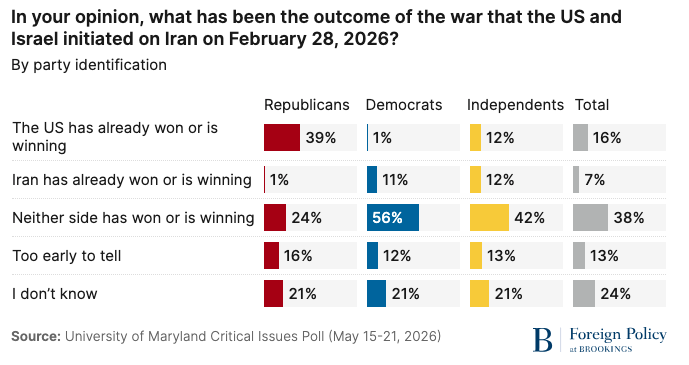
Telhami concludes that “our latest poll brings home the rising public fear that, regardless of the aims of the war, the United States is not perceived to be winning by any segment of the public including older Republicans, and that Americans decidedly view the impact of the war to be detrimental to U.S. interests. It’s hard to imagine that extending the war further could reverse the tide of public attitudes.”
The second article is coauthored with Calvert Jones and Marc Lynch and is based on the spring Middle East Scholar Barometer. It assesses how Middle East scholars view AI and how much they use it in their professional capacity. We found that AI is entering this field unevenly, and often uncomfortably. Most said that AI has not affected their teaching, but those who said that it had were nearly unanimous in describing the effect as negative.
As they note in the article, “There was also a remarkable difference in how scholars perceive the effects of social media versus AI on broader public discourse. Regarding Israel-Palestine, 25% said AI-generated propaganda and disinformation had shifted U.S. public opinion more in favor of Israel (with only 13% saying more in favor of Palestine). Yet 64% said social media platforms like X and TikTok had moved opinion more in favor of Palestine. In other words, scholars perceive these two technologies as pushing public opinion in opposite directions.”
You can find the latest article based on the Critical Issues Poll here, and the latest article based on the Middle East Scholar Barometer here.